
Barbecue, Beef Brisket, Technology
Brisket Cook & Sous Vide Hold Calculator
Sep
Cooking to a deadline? Run your weight and dinner time through the Brisket Cook Time Calculator first.
Your Brisket Isn’t Done When You Pull It
Every brisket guide ends the same way: probe tender, around 203°F, then rest it. That’s where the advice stops, and that’s the part that costs people a great brisket.
Because at the moment you pull that brisket off the smoker, it’s only about 60% rendered.
What “rendered” actually means
Two things make brisket brisket. Collagen — the tough connective tissue webbed through the point and flat – breaks down into gelatin, which is what gives properly cooked brisket that tender and juicy. And intramuscular fat melts and redistributes. Neither of those is a switch that flips at a magic temperature. Both are slow chemical processes that depend on how long the meat sits at what temperature.
That’s the key idea. Not the temperature you hit. The time you spend there.
And the relationship is steep. The rate roughly doubles for every 13°F of internal temperature. Run that out and it means one hour at 203°F does about as much work as seventeen hours at 150°F. The last ninety minutes of your cook are worth more than an entire overnight hold.
It turns out that professional pitmasters have known this for quite a while and have been using the hold to serve the worlds best bbq.(more info below the calculator)
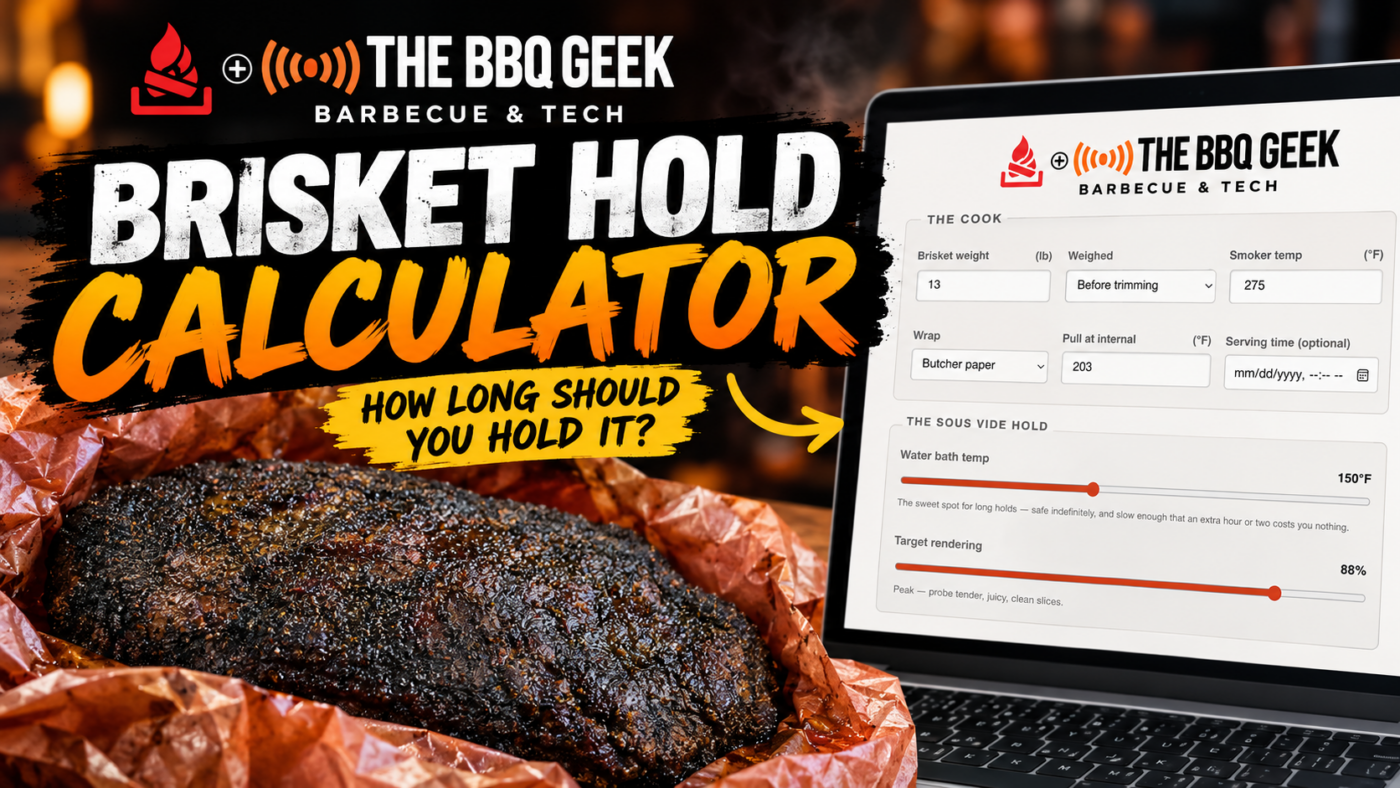
The Brisket Hold Calculator
Estimates only. Rendering is modelled from time at internal temperature; real briskets vary with grade, fat content, and how hard your pit runs. Cook to feel, not to a number — and never hold below 130°F.
Why the number is only 60%
Here’s the thing about a brisket climbing to 203°F: it doesn’t spend much time up there. It crawls through the stall in the 150s and 160s, where rendering is slow, then sprints through 190-203°F in well under an hour – right where rendering is fastest. You get a lot of clock time in the zone that barely does anything, and barely any time in the zone that does the most.
So you pull a brisket that’s probe tender and genuinely good. It just isn’t finished.
Where the rest of the work happens
This is the part that surprised me when I ran the numbers.
When you drop that 203°F brisket into a 150°F water bath, it doesn’t teleport to 150. It coasts down over the next couple of hours, passing back through 190, 180, 170 – the fastest-rendering temperatures there are. That descent alone is worth roughly seven extra hours of holding at 150°F.
Then the steady hold does the rest, slowly and predictably, for as long as you leave it.
So why sous vide instead of a cooler?
Not because a cooler renders badly. A faux cambro actually renders aggressively – it holds the brisket high for hours as it slowly falls, and can do plenty of work.
The problem is you have no idea where it’s going to land. Every cooler is different, every ambient temperature is different, and the brisket keeps falling the whole time – eventually toward temperatures where you’ve got a food safety problem instead of a brisket.
A sous vide bath catches the brisket at a temperature you chose and holds it there indefinitely. Same result every time. And it turns your serving time into something you control instead of something you pray about – hold it four hours or twenty, and dinner happens when you say it does.
How to use the calculator
Punch in your brisket weight, your pit temp, whether you’re wrapping, and where you’re pulling. Set your bath temperature and how done you want it. It’ll tell you how long the cook runs, how far along you’ll be when you pull, and exactly how long to hold to finish the job.
Add a serving time and it works backwards to tell you when to light the fire.
On safety: hold at 145°F or above and you can leave it as long as you like. Below 140°F, keep it short. The calculator won’t let you talk it into a hold that its own temperature can’t support.
One honest caveat: these are fitted estimates, not laws of physics. I calibrated the model against cooks with known outcomes, and it lands where experience says it should. But your pit, your brisket, and your grade of beef all vary. Use it to plan, then trust your probe.
The Brisket Hold Checklist
Before the cook
- Weigh the brisket before trimming and note it – a 13 lb untrimmed packer loses about 20% to trim and cooks like a 10.4 lb brisket.
- Decide your pit temperature before you light the fire. A 13 lb packer takes about 10 hours at 275°F, about 13 hours at 250°F, and about 20 hours at 225°F.
- Fill and preheat the sous vide bath before the brisket is ready to come off. The brisket should never wait on the water.
- Work backwards from your serving time and add at least 2 hours of buffer. The hold is what absorbs a cook that runs long.
During the cook
- Wrap when the bark is set and won’t smudge under your thumb — usually around 160°F internal.
- Butcher paper cuts total cook time by roughly 10%; foil cuts it by roughly 18%.
- Ignore the clock and start probing at 195°F internal. Time estimates get you near the finish, not to it.
- Pull when the probe slides into the thickest part of the flat with no resistance – typically 200–205°F.
Going into the hold
- Get the brisket into the water bath immediately after pulling. Do not let it cool on the counter.
- Bag it or wrap it tight so bath water never touches the meat. Vacuum seal or a large food safe zip bag with the air pressed out both work.
- Set the bath to 145–155°F for a long hold. This is the range that is both food safe indefinitely and slow enough to be forgiving.
- Leave the wrap on. You are holding the brisket, not steaming it.
During the hold
- Hold at 150°F for 12–16 hours to take a brisket from roughly 60% rendered off the pit to roughly 87-90%.
- Hold at 160°F for 8 hours if you are short on time – it reaches roughly 89% but overshoots badly if you leave it overnight.
- Never hold below 130°F. That is the bacterial danger zone.
- Keep any hold below 140°F under about 6 hours. At 145°F and above you can hold as long as you like.
- Stop before 36 hours. Past that the muscle fibers go mealy even though the rendering numbers still look good.
Before serving
- Pull it from the bath and let the surface dry for a few minutes before slicing.
- Slice against the grain, and re-orient the knife where the point and flat grains diverge.
- Slice only what you are serving. The rest holds better whole.
Quick Answers
How long should you hold a brisket in a sous vide?
Hold a brisket at 150°F for 12 to 16 hours. That takes it from roughly 60% rendered when it comes off the smoker to roughly 87-90% rendered, which is the peak texture window. At 160°F the same result takes about 8 hours.
What temperature should you hold brisket at?
Hold brisket between 145°F and 155°F. At 145°F and above it is food safe indefinitely, and the rendering is slow enough that an extra hour or two makes no meaningful difference. Never hold cooked brisket below 130°F.
Is a brisket done when it hits 203°F?
No. A brisket pulled at 203°F is only about 60% rendered. It is probe tender and edible, but collagen breakdown and fat rendering are time-at-temperature processes that continue during the hold, and most of the remaining work happens after the brisket leaves the smoker.
Why hold a brisket in a sous vide instead of a cooler?
A cooler renders aggressively but uncontrollably – the brisket falls in temperature the entire time and eventually drops toward unsafe temperatures. A sous vide bath catches the brisket at a chosen temperature and holds it there indefinitely, so the result is repeatable and the serving time is yours to pick.
How long can you hold a brisket safely?
Indefinitely at 145°F or above, because that temperature is above the range where bacteria multiply. Below 140°F, limit the hold to about 6 hours. In practice, stop at 36 hours regardless of temperature, because texture degrades before safety does.
Does resting a brisket actually do anything?
Yes, and it does far more than redistribute juices. Rendering rate roughly doubles for every 13°F of internal temperature, so the hours a brisket spends between 150°F and 190°F after it leaves the smoker continue breaking down collagen. The coast down from 203°F to a 150°F bath alone does as much rendering as about 7 extra hours of holding at 150°F.
How long does it take to smoke a brisket?
A 13 lb untrimmed packer takes about 10 hours at 275°F, 13 hours at 250°F, or 20 hours at 225°F, wrapped in butcher paper. Cook time scales with thickness more than weight, so an 18 lb brisket takes about 12 hours at 275°F rather than 14.
